The Jean Manifesto
Announcing Jean Connect
Over the last several years, our relationship with computers has changed. Machines are now able to handle more complex tasks and free up human focus towards more important work [1]. However, there remains a gaping hole in the solutions we have built to date. We should not forget that while the external world is complex, we too are complex beings and AI can help us navigate even the most human problems.
In the future, there will be 1,000s of applications of AI. Regardless of how smart these models become, they will always require context from our lives to act on our behalf.
Thanks for reading Engineering the Future! Subscribe for free to receive new posts and support my work.
The infrastructure to support the next decade has not yet been built, but it is now clear what form it will take.
Our Core Conviction
Computers now understand humans.
The world woke up the day that ChatGPT appeared to pass the Turing test. It was a shock that something artificial understood the world just as we do. If you speak with these models, you learn that they also grasp unique personalities and behaviors. The very important afternote that no one is talking about is that these models, through training on large corpuses of human data, have learned patterns of human thought.
In many cases, interactions with AI just feels to be a spark of something more, where a model may call out a blind spot you have that feels obvious in retrospect. In some cases, these models peer into our soul with a depth that feels alien.
We are about to confront the most consequential questions in human history. In technology, we don’t think about the present or the y-axis. We think in terms of rate of growth and slope. The proper framing of the question we should not be so quick to dismiss is “what will this technology mean for us after 10-25 years of exponential improvements?"
The logical answer is that these machines will understand humans better than we understand ourselves [2]. The human mind will be mapped completely.
Why This is Important
There are implications for a future where a single machine can understand billions of humans.
Even with today’s shallow ads and recommendation systems, the human impulse for freedom and privacy fights back. When Target used simple pattern recognition to predict that one of their customers was pregnant, the world reeled [3]. To the unfamiliar, these older systems feel like they understand you, but they are just providing you recommendations based on what items people similar to you have bought.
We should learn from the past, but much of what makes up modern AI is very different from older machine learning. What ChatGPT represents is not simple pattern matching but the introduction of software that truly understands you and your unique pains and desires [4].
In the near future, all advertisements and software will morph to the individual. In many cases, this will lead to positive experiences, such as an assistant that knows your calendar and personality so it can act on your behalf. And in many separate cases, the market will capture this context for use in highly targeted advertising and addictive programming [5].
Why This is Inevitable
The infrastructure required for this future will be built. Current applications of AI are not what they could be, simply because individual context is not accessible by these models. It is obvious as an afterthought that this software needs to have context of our lives to act on our behalf.
Many understand that the industry’s potential is still stunted because:
-
LLMs do not remember – across applications and even across chats.
-
AI is trained generically – personalized experiences require personal context.
-
Context is siloed – each app sees a narrow window into your life, your code is on Cursor, your social circle is on Meta, your shopping preferences are on Amazon, etc.
Jean has now built this infrastructure, and it is clear what the end-state looks like. Up until recently, there have been barriers that have held this industry back, but they have been slowly resolved and progress has been unlocked. The convergence of the following developments make this piping possible.
-
Context Engineering - The simple practice of providing an AI select, relevant context on the individual is required for personalized experiences [6].
-
AI Memory - Ensuring context is stored and retrievable for users requires architectures that embed and graph memories so that relevant context is one query away [7].
-
Model Context Protocol (MCP) - MCP represents standardized piping across AI applications, where the flow of context in and out of an application is simple to set up. Soon, MCPs will be standard one-click installs across the industry, breaking down silos of data [8].
We believe that the required solution is naturally a utility. Some companies are starting to wake up to the importance of this infrastructure and OpenAI has explicitly cited the opportunity to build a “Sign in with OpenAI” SDK across software, where your memories and context come with you.
We are not disillusioned to assume that this infrastructure must be trusted because individuals will choose to own their data. Movements to restore data sovereignty of the past simply fail to capture the attention of the consumer. Game theory asks us for a neutral solution. It is the very fact that all the tech companies want to own this connective tissue that none will allow each other to. The solution is a trusted, 3rd-party utility, like Plaid.
What Jean is Building
“Jean is building the infrastructure for computers to understand us.”
“Our mission is to ensure AI applications understand users consistently by providing persistent, cross-platform memory that surfaces relevant personal context when needed.”
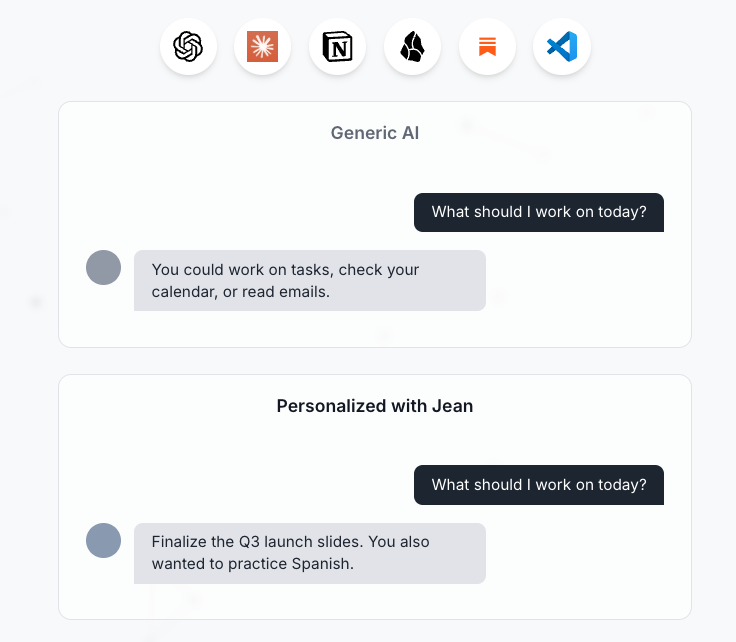
Jean is solving the problem that AI applications do not have access to user context to personalize experiences and act on their behalf.
Current Customers
Our current customers are consumers looking to have consistent memory across their apps and developers building memory into applications. While we are also excited by this opportunity, we see a larger opportunity to build the connective tissue for tomorrow’s personalized internet.
New Product: Jean Connect
We are launching a simple path for AI Applications to let their users bring in their memories, context, and indeed deep understanding into the platform. These systems are complex and we strive to distill this complexity into just 5 lines of code [9].

With this context, businesses and applications can provide profoundly personalized experiences, improving the value of your own product and delighting customers in the process.
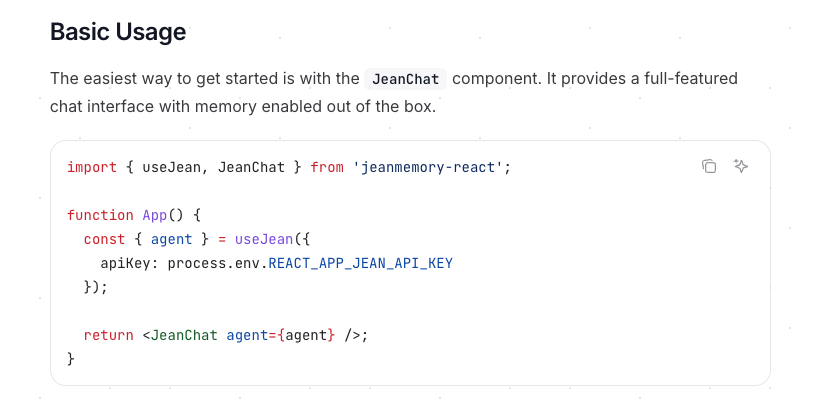
* See our documentation for how to simply implement this into your application.
[1] Politzki’s Law
[2] General Personal Embeddings
[3] How Target Figured Out A Teen Girl Was Pregnant Before Her Father Did
[4] Jean - Software for the Individual
[5] Deep User Understanding From Day One
[7] B2C Memory Layer
[8] MCP, A2A, and the Future of AI Infra
Thanks for reading Engineering the Future! Subscribe for free to receive new posts and support my work.