Invention
Human ingenuity
To invent - To invent means to design, create, or originate something that has never existed before through mental effort and ingenuity.
How does one invent something? What does it take? To answer this question, you could read biographies of people who have invented things. You could also try to invent things. This feels like what I have done in Silicon Valley.
What does it feel like to invent something? I imagine that most people in the world have both never invented anything and also invent solutions every day, they just never realize it. Human ingenuity is how we solve problems and make it through our difficult lives.
If you wanted to invent something, where would you start? An invention, if it is to be useful, must solve a problem. At least that’s what I think one would say. But picking a problem is also its own endeavor.
Size of Problems
An invention can be small or large, just as a problem can be small or large. A small problem can be solved in hours or days. And a large invention may only be solved over years with concentrated resources, like the atomic bomb. Breaking it down and solving smaller pieces. A big problem requires one to wrap their entire mind around it and chew and chip away at it for a long duration of time.
History shows us instances where one directionally invents something that solves a problem that surfaces years later in another field (the invention of the transformer, or Chern–Simons theory, which found its use in physics decades after the math was worked out). Or it takes time to really digest an invention.
Originality of Problems
Invention is difficult on an axis of originality. Something too out of bounds and no human can even understand it. One can imagine an invention that solves a problem that people did not know was a problem yet. Something like a second-order invention. Or a completely original idea. Where did that even come from? Einstein’s equations are remarkably novel and detached from the common mind.
I watched a movie the other day that I thought did a really good job at capturing an inventor’s choice of problems called A Beautiful Mind. The movie depicts the tragic life of John Nash, a mathematician at MIT. Nash was viewed as a lunatic and asshole. He wanted to solve a problem that was truly original.
But it was only because he was crazy enough to pursue crazy ideas that he was able to solve a really big problem.
And also…
“As the story goes, Nash was at MIT being his usual brash, irritating self, and a senior colleague named Warren Ambrose—who was fed up with him—threw out a sarcastic challenge along the lines of “if you’re so brilliant, why don’t you go solve the embedding problem?” It was meant as a put-down. Nash took it literally and went and did it.”
Importance of Problems
Mathematics is pure problem solving. Startups are the only work I’ve ever seen that is like this. You get compensated based on the size of the problem you solve. And it captures something about the human aspect of solving hard problems. Not all problems lead to any change in the world. A great startup solves an important problem that changes how every human lives their lives.
But this means that we have to choose the right problems to work on.
The Hubris of Invention
What goes into choosing a problem? We can choose to only work on completely original, large, and important problems, but these mountains are difficult to scale.
In that time, a mathematician may go unemployed if they do not produce results. Or a startup may die. You may need to convince others that this uncertain problem is worth one’s resources, and indeed, you may need to convince yourself.
To try to solve a large problem means to think you can solve it. What could possibly make you think you can solve it? Is it hubris? Risk appetite? Irrationality? Stubbornness? Pure insanity? Ambition? A chip on one’s shoulder? There is some blend of human emotions that can approximate or present themselves as insanity, idiocy, ambition, and disagreeableness.
In order to justify this internally as an inventor, you must have an internal belief system that outweighs the crowd. The belief you are right and others are wrong.
In addition, it is likely true that some other factors come into play. Probably many others at the margin.
invention is high-risk:high-reward
the timing has to be right for winning, market adoption, and whether the tech is even possible
it will absorb every minute of your mind. You have to be able to dedicate that.
if you look at invention, it often occurs through pockets of smart people working on adjacent problems in close proximity
you have to be smart enough to solve the problem
you must have a belief that all that exists today is not that it can be
the german engineer sits on problems longer
the belief you can solve a problem
the flexibility at the edges to reassess priors
near impossible to get people to solve your problems and very few will see what you do
if you are going to get great people to join you must be able to get people to follow you. Maybe you need to raise money to even have a shot.
doing new things is really difficult
Human Ingenuity
And as I think about the nature of invention, it parallels how I have experienced my own life. As a young person, you are constantly reinventing yourself. And this reinvention sits at some point along an axis of (contentment & comfort & stagnation) and (strong internal dissatisfaction and the need for more). In between, there is a leap of faith and some blended storm of human emotion.
In the film, Nash’s desire to solve a truly original, groundbreaking problem stems from his crippling fear of mediocrity. This feels surprisingly relevant.
In Silicon Valley, this part would never be in a pitch deck. The way it is framed is we want to make the world a better place. How could you communicate to a crowd the boldness that you are the person who can?
Classically, it is presented through a combination of earnestness and curiosity. And often, this is the case. “Because I find it interesting and an important problem.” Fair enough.
Another case is someone who has proven an ability to solve large problems. When the founder that solved DNA sequencing tells us they want to cure cancer, we give them some benefit of the doubt.
The Crazy Ones
But if it wasn’t for this wild brew of human emotions and boldness, the world would never change. Only through random discovery.
Failure
After attempting to invent new technologies, I’ve observed that the more original and difficult problems usually do not work. Or they take longer. Maybe you find 99 ways not to build a lightbulb.
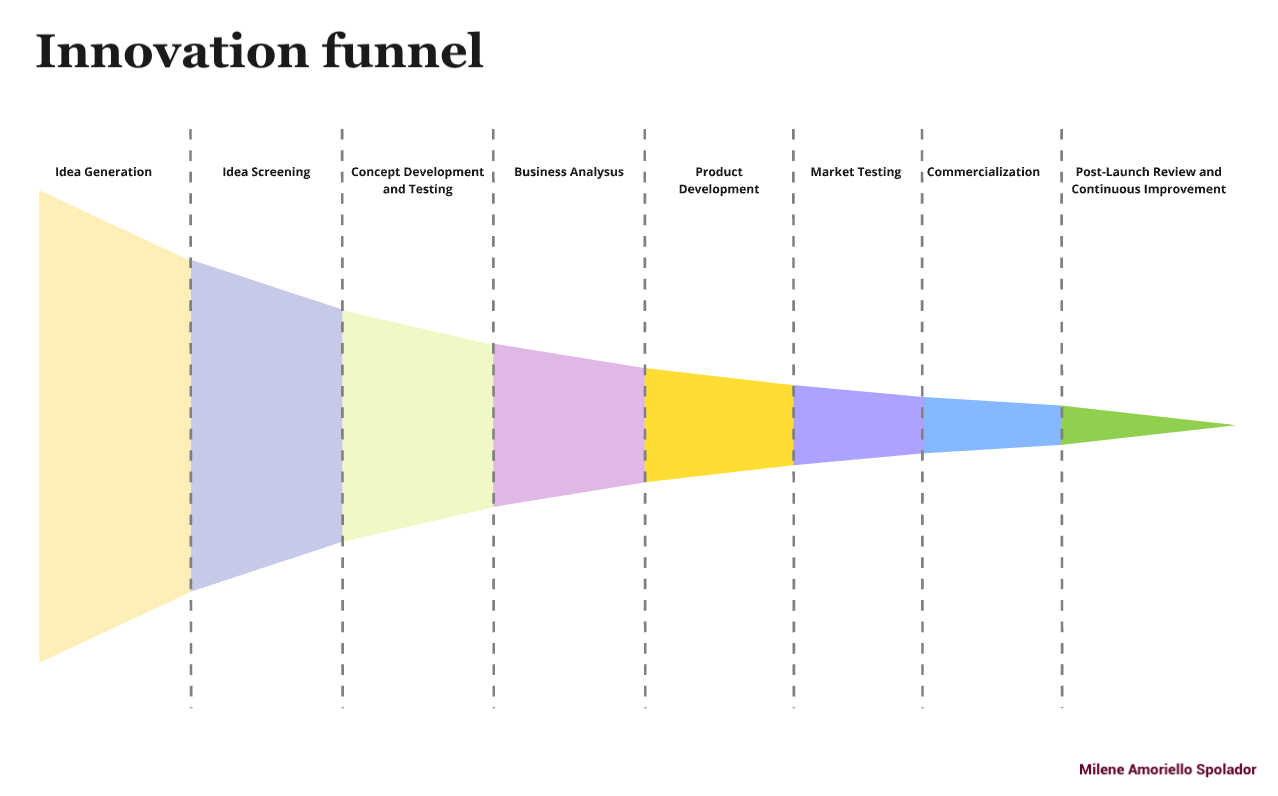
And this is the nature of invention and venture. Most startups fail. And most inventions do not amount to anything. But the few that do work outweigh all the failures.
It may even be true that you were correct, but someone was more correct. Or it may be true that the timing is wrong. At least as an inventor, you can be comforted by the fact that there are an endless number of problems in the world. To an inventor, failure is irrelevant unless it is catastrophic.
The mental toll
Silicon Valley works because the few that do pay for all the failures. Though to the individual companies and individual inventors, that’s not very comforting. You still failed. If you can’t get others to follow you and you can’t solve the problem, do you give up? Maybe you even still deeply believe that the problem is solvable, but you aren’t sure if it can be solved within 5 years.
Leadership
It is difficult to solve important problems in a vacuum. It is important to work with smart people. In order to do so, you have to convince them that a problem is important, solvable, and that you can solve it.
Most people are very risk-averse and not crazy. Which is probably a good thing.
But somehow you need crazy people. At Nephra, we tried to solve an impossibly hard problem. Some of the best people I worked with still had to look out for themselves. “I’m not sure I want to die on this hill.”
Or maybe a company will choose to go after an easier problem. One that is less consequential but has lower risk.
Experience with Hard Problems
I have a curse where I only want to work on hard problems. When you start a company, you get to choose the size of problems you work on. Throughout my history of starting things, I have always made the very conscious decision to work on extremely difficult problems.
Outwardly, this is a decision. But internally it doesn’t feel like a choice. I have to solve a hard problem. Some mental mix of the above emotions, maybe it is some bit of naivety, and anything less is just boring.
When I first started working on Jean, the realization that started everything hit like pure inventive dopamine. Not far from the feeling of winning the lottery. Everything in my life, my interests, my ambitions, seemed to click into place. I had no assurances. I had no practical grounding in whether it was even possible. What I had was complete irrational conviction. The kind you feel maybe once every few years, where you can’t prove anything, and yet you know you’re right. And you trust it, because you’ve felt this conviction before, and it was right before.
Maybe years later, you’re still working on the same meaty, gigantic problem. Technology has started to click around you. Things that weren’t possible are becoming possible. Someone publishes a paper proving your initial thesis with logic and evidence, and it feels good, but it almost doesn’t matter. You already knew you were right. Because every day you asked yourself if you were wrong.
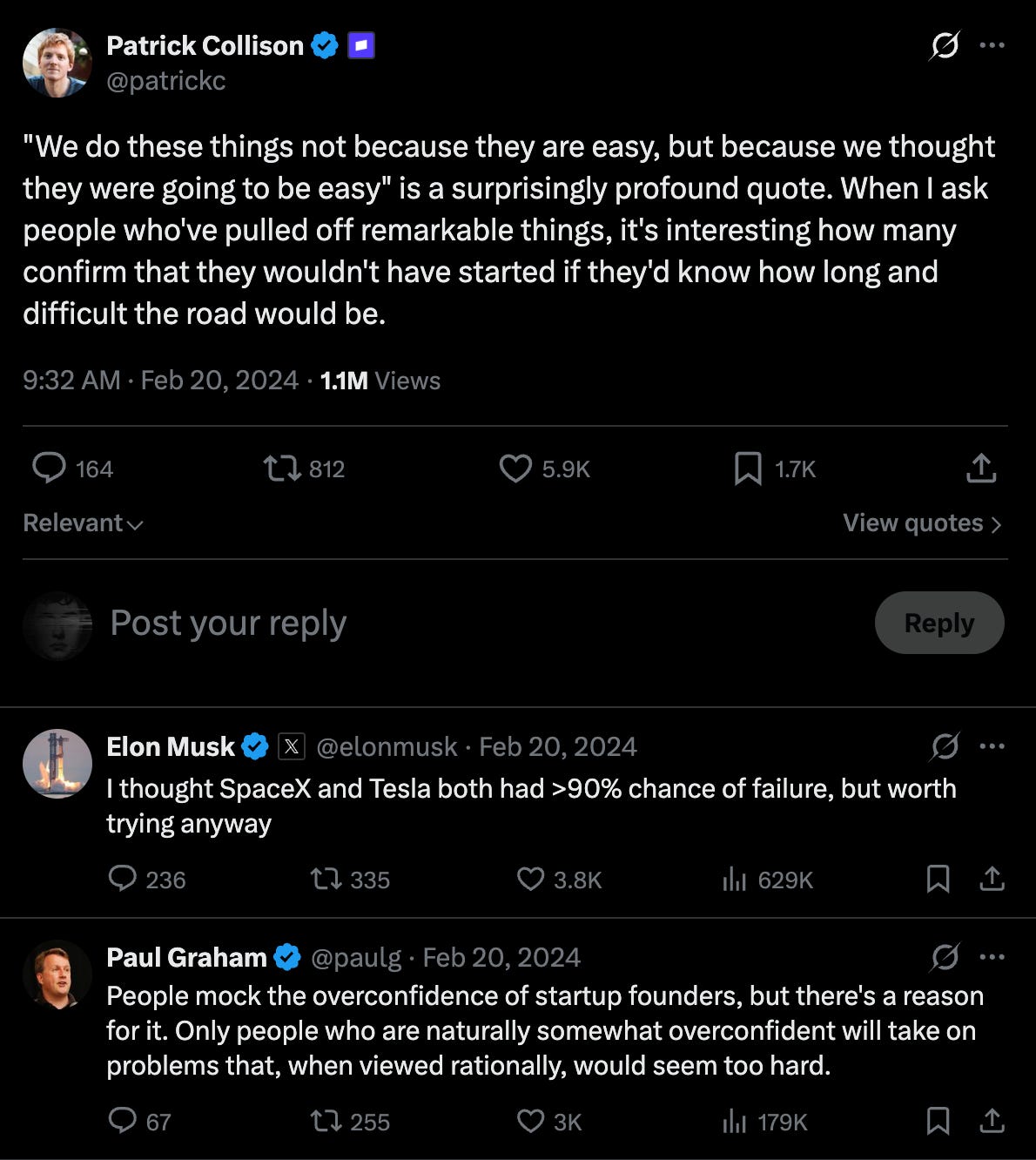
“We do these things not because they are easy, but because we thought they would be easy.”
But if we were wise enough to know before, we would never do anything. And NVIDIA would not exist.
Silicon Valley
And Paul is correct about startups. He is also correct about Silicon Valley as a whole. The rest of the nation mocks Silicon Valley. Even living in the place, it has so many problems. Everyone is pitching their thing, and it is mostly noise.
From afar, we can observe Silicon Valley’s absolute insanity, but we also see its fruits. If not for The Bay Area, we would not have the iPhone. If not for its creations, perhaps we would just bomb the place.
If we did bomb it, we may not even notice the difference. But that’s the problem. Nothing would change.
The Midwest
In fact, if you speak with companies in the midwest, nothing has changed. They are just now starting to adopt AI (which may just be Microsoft Co-Pilot to them). It’s like a part of America has been trapped in a time capsule.
One thing that is noticeable about the midwest is they view technology as a commodity. As if there is no difference between a frontend UI programmer and a Member of Technical Staff at Anthropic.
Equally, we can mock the midwest and NYC. But if we bombed the midwest and Financial Capital of the world, we would definitely notice.
No one is going to tweet about the logistics, industrials, and CPG companies in the midwest, but they are ground that we walk on. It makes sense that they are optimized for stability. I was very drawn to Silicon Valley because that was my only experience with the world. I thought the entire world was this way.
But if you’ve got a good thing going, you’d rather the rest of the world deal with the risk and figure it out before it gets to you.
The Balance of Stability and Invention
If you are the United States, your stability is more of a feature than it is a bug. If you are a mature company, this is also true. Mature companies usually dedicate a portion of their budget to R&D.
I’ve grown to appreciate Silicon Valley as what it is, it is the hot bed for innovation. A pressure cooker for new ideas. Silicon Valley can only be understood as an invention machine.
It makes sense that it has organically grown and evolved in this way as a major organ of the United States. Where ironically if you are one of the few successful companies, you may graduate from it.
The Last 10 Years of Technology
What we witnessed since the arrival of ChatGPT was a fundamental change in what is possible in the world. An extremely original and important and valuable invention.
But those who understood this technology knew that the possibilities were more. This was a machine that approximated intelligence. If that was true, we could build agents and automations that could automate low-complexity work in a way that software could not years prior.
Then it was a question of how and who would solve the smaller problems on top of this foundation. Memory, better data feeding the machine, structured output, retrieval, context engineering, agents, harnesses, frameworks. None of these were as incredible of an innovation. And after the arrival of an LLM, in retrospect they were obvious (relatively).
This sparked a flurry of innovation that was remarkable to be a part of. However, the majority of innovation fails. This was an accelerated cycle of evolution. I do believe that the building blocks all being in place were the most fundamental and core innovation, and that ~80% of the innovation for the next 5 and potentially years is already here. Over time, people will still realize that AI is more than just an LLM. But for now, we should probably just focus on what works.
And so the idea of running back toward that stack, a stack that is mostly built, flooded with more capital than any technology wave in history, feels completely, irrationally bold. Stupid, actually.

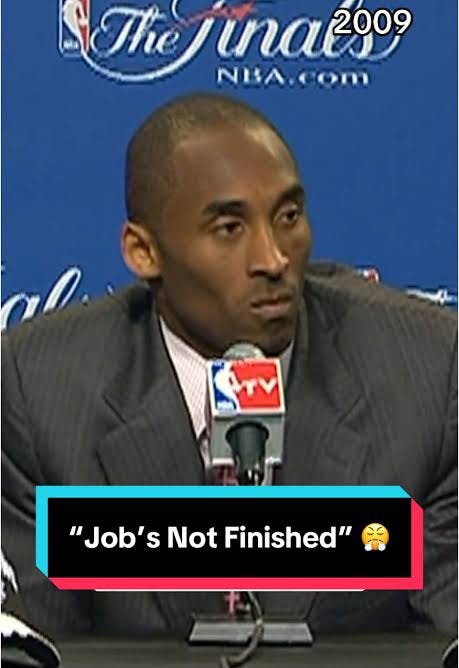
But I feel the same way I felt at the beginning. Foundation models are not all they can be. The problem is still there. The job’s not finished.